In this guide
Executive summary: key differences at a glance
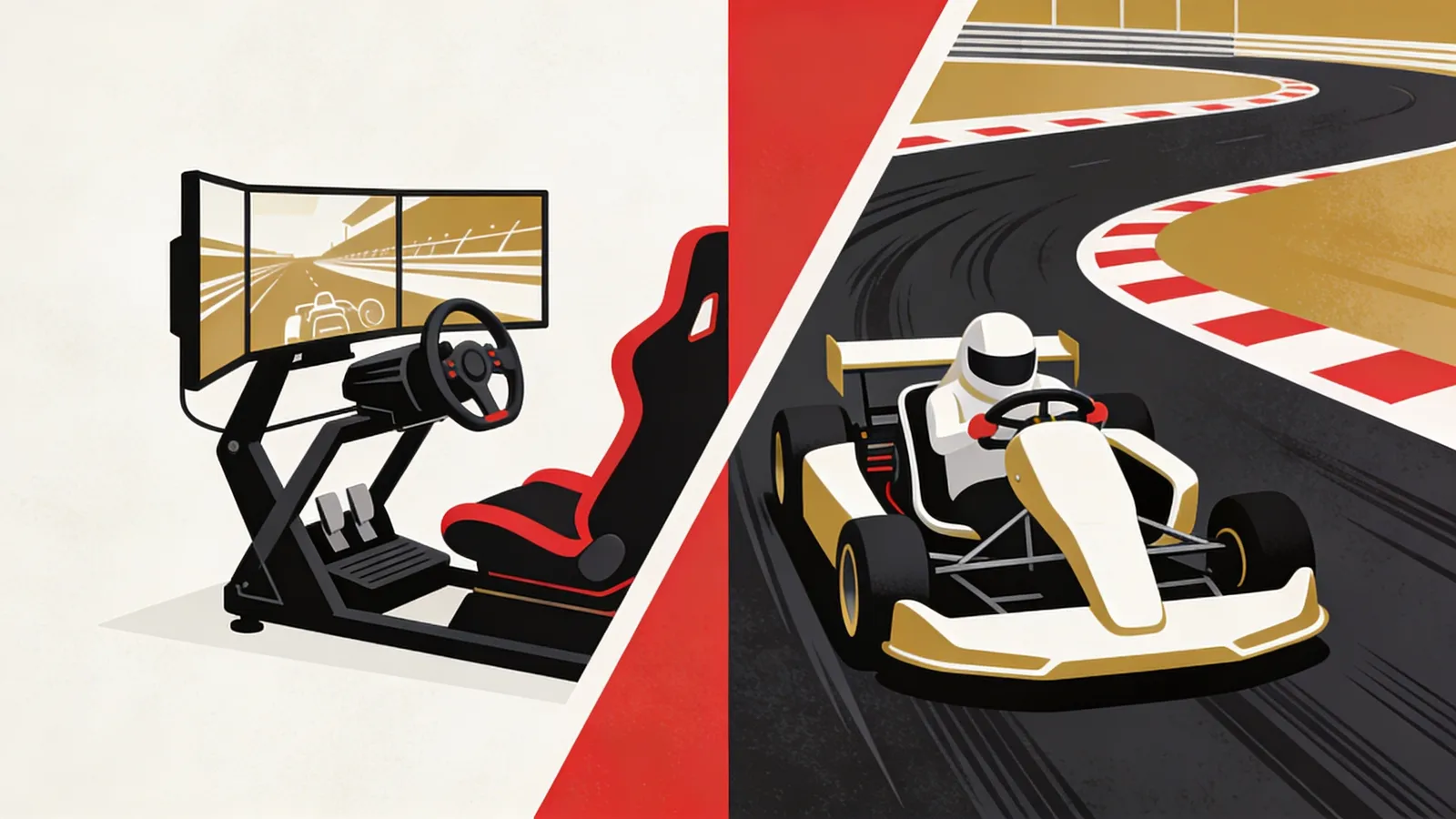
Both sim racing lounges and go karting tracks offer exciting entertainment business opportunities, but they differ dramatically in capital requirements, operational complexity, and growth trajectories. This comparison helps you decide which model fits your budget, market, and risk tolerance.
Quick comparison
| Factor | Sim Racing Lounge (8 bays) | Go Karting Track (8 lanes) |
|---|---|---|
| Startup capital required | $50K-100K | $200K-500K+ |
| Space needed | 2,000-3,000 sq ft indoor | 10,000-30,000+ sq ft (often outdoor) |
| Location flexibility | Industrial or commercial zones | Large plots, specific zoning required |
| Weather dependence | None — fully indoor | High for outdoor tracks |
| Staffing needs | 1 manager + 4-6 part-time | 2 managers + 8-12 staff |
| Maintenance complexity | Moderate (electronics, PCs) | High (engines, track surface, safety) |
| Average session price | $30-45 | $25-40 per race |
| Sessions per hour capacity | 16 sessions (8 bays × 2 turns) | 24-32 karts per heat |
60-75%
Lower startup costs for sim racing vs karting
Year-round
Sim racing operates regardless of weather
27% annually
Sim racing market growth rate (vs. 3-5% for traditional karting)
6-12 months
Typical time to profitability for both models
Bottom line
Sim racing requires less capital, offers more location flexibility, and has lower ongoing maintenance. Go karting has higher capacity per hour but significantly more operational complexity and weather risk.
Startup costs comparison
Capital requirements are the biggest differentiator between these business models. Sim racing can be launched with a fraction of the investment needed for go karting.
Sim racing lounge (8 bays)
Equipment costs
$25,000-70,000 depending on tier. Mid-range build with Moza R9 wheels and SimLab rigs runs ~$45K.
Build-out & renovation
$15,000-35,000 for electrical upgrades, networking, lighting, paint, flooring in 2,000-2,800 sq ft space.
Software & tech setup
$2,000-6,000 including booking platform, POS hardware, lounge TVs, security cameras.
Working capital reserve
$15,000-25,000 for 3-6 months operating expenses during ramp-up.
Total estimated
$57,000-136,000 (mid-range target: ~$85K)
Go karting track (8 lanes)
Track construction
$100,000-250,000+ for outdoor track build including surface, barriers, runoff areas. Indoor tracks cost significantly more.
Kart fleet (20-30 karts)
$60,000-90,000 for quality electric or gas karts at $2,500-3,500 each plus spare parts inventory.
Facility build-out
$50,000-100,000 for pit area, spectator seating, concession space, restrooms in 10,000+ sq ft facility.
Safety equipment & licensing
$10,000-20,000 for helmets, barriers, timing systems, safety certifications.
Working capital reserve
$30,000-50,000 for 6 months operating expenses (higher staff costs).
Total estimated
$250,000-510,000+ (mid-range target: ~$350K)
Financing implications
The capital difference affects financing options:
- •Sim racing: Often achievable with SBA loan + personal investment. Lower risk profile appeals to traditional lenders.
- •Go karting: Typically requires significant equity investment, equipment financing for karts, and potentially investor capital.
“We considered both models seriously. The go karting opportunity was compelling but required $400K we didn’t have access to. Sim racing let us launch with $85K and prove the market before considering expansion.”
Space and location requirements
Location flexibility is a major advantage for sim racing. Go karting requires large plots of land with specific zoning that’s increasingly difficult to find in growing markets.
Sim racing space needs
Go karting space needs
Real estate availability
In most metropolitan areas:
| Market Type | Sim Racing Availability | Go Karting Availability |
|---|---|---|
| Major metro (LA, NYC, SF) | Moderate — competitive but options exist | Very limited — few suitable parcels available |
| Secondary market (Austin, Denver) | Good — ample industrial/commercial space | Limited — requires specific zoning approval |
| Suburban/rural | Excellent — many affordable options | Good — land more available but customer base smaller |
Location insight
Sim racing is destination entertainment — customers will drive 15-20 minutes for quality. You don’t need expensive retail frontage, which dramatically expands location options and reduces rent costs.
Operating expenses breakdown
Ongoing operational costs favor sim racing due to lower staffing needs, simpler maintenance, and no weather-related closures.
Monthly expense comparison (8-bay/8-lane equivalent)
| Expense Category | Sim Racing Lounge | Go Karting Track | Notes |
|---|---|---|---|
| Rent ($/sq ft) | $2,500-6,000 (2,400 sq ft @ $1-2.5/sq ft) | $8,000-20,000+ (15K sq ft @ $0.50-1.30/sq ft) | Karting needs more space but often cheaper per sq ft |
| Staff salaries | $4,000-10,000 (manager + 4-6 part-time) | $8,000-18,000 (2 managers + 8-12 staff) | Karting requires more safety staff and track marshals |
| Equipment maintenance | $500-1,500/month reserve | $3,000-6,000/month reserve | Karts need constant engine work, track surface repairs |
| Insurance | $300-800/month | $2,000-5,000/month | Karting has significantly higher liability exposure |
| Utilities | $800-1,800 (electricity intensive) | $600-1,500 (mostly lighting/AC) | Sim racing PCs draw significant power |
| Software subscriptions | $200-600/month | $300-800/month | Both need booking systems; karting may need timing software |
| Total monthly | $8,300-20,700 | $21,900-51,300+ | Sim racing typically 40-60% lower operating costs |
Maintenance complexity
Sim racing maintenance
PC dust cleaning, software updates, wheel/pedal inspections, occasional component replacements. Can be handled by tech-savvy owner with basic training.
Go karting maintenance
Engine tuning and rebuilds, clutch adjustments, tire changes, track surface repairs, barrier inspections. Requires specialized mechanical knowledge or dedicated mechanic on staff.
Weather impact
Outdoor go karting tracks face significant weather-related revenue loss:
- •Rain closures: Track unsafe when wet; typical loss of 10-20 operating days per year in most climates
- •Extreme heat/cold: Reduced customer comfort and safety concerns limit operations
- •Sim racing advantage: Fully indoor operation with climate control — zero weather-related closures
“Our outdoor karting track lost an estimated $45,000 in revenue last year from rain and extreme heat days. We’re now exploring adding a sim racing annex to capture that lost capacity.”
Revenue potential analysis
Both models can be profitable, but they have different revenue characteristics. Go karting has higher hourly capacity; sim racing has better margins and recurring revenue through memberships.
Capacity comparison
| Metric | Sim Racing (8 bays) | Go Karting (20 karts) |
|---|---|---|
| Sessions per hour | 16 sessions (30-min turns) | 40-50 racers per heat × 2 heats = 80-100 |
| Operating hours/day | 14 hours typical | 10-12 hours (sunlight dependent for outdoor) |
| Daily capacity | 224 sessions | 800-1,200 racer-slots |
| Average price per session | $35 | $28 per race (often buy 2-race packages) |
| Theoretical max daily revenue | $7,840 at 100% utilization | $22,400-33,600 at 100% utilization |
Realistic revenue (at typical utilization)
At industry-average utilization rates:
| Facility Type | Utilization Rate | Monthly Revenue Range |
|---|---|---|
| Sim racing lounge (8 bays) | 60% average | $28,000-42,000 |
| Go karting track (outdoor) | 50% average (weather impact) | $35,000-55,000 |
| Go karting track (indoor) | 65% average | $50,000-75,000 |
Revenue stream diversity
Sim racing revenue streams
Pay-per-session (45%), memberships (35% recurring), corporate events (15%), tournaments/coaching/retail (5%). Membership model provides predictable MRR.
Go karting revenue streams
Race sessions (70-80%), party/event bookings (15-20%), concessions/merchandise (5-10%). Less recurring revenue, more transactional.
Profitability timeline
Margin insight
Sim racing has higher gross margins (70-80% after variable costs) compared to go karting (50-65%) due to lower equipment depreciation and maintenance expenses.
Customer demographics and seasonality
Understanding your target customer helps determine which model fits your market better. Both attract entertainment-seeking customers but with different demographic skews.
Demographic comparison
| Demographic | Sim Racing Lounge | Go Karting Track |
|---|---|---|
| Primary age range | 21-45 (tech-savvy adults) | 8-35 (families and young adults) |
| Gender split | 70-80% male, 20-30% female | 60-70% male, 30-40% female |
| Income level | $60K+ household income typical | Broad range — more accessible pricing |
| Group size | 1-4 people typically | 4-10 people (larger groups) |
| Repeat visit rate | High with membership model (weekly/monthly) | Moderate (monthly/quarterly for families) |
Seasonality patterns
Sim racing seasonality
Minimal weather impact. Slight dips in January-February post-holidays, peaks June-August and September-November. Corporate events drive Q1 and Q4.
Go karting seasonality
Significant for outdoor tracks. Peak May-September, sharp decline November-March in colder climates. Indoor tracks have flatter year-round demand.
Market saturation
Competition landscape varies by market:
- •Sim racing: Still emerging category with limited competition in most markets. First-mover advantage significant.
- •Go karting: Mature industry with established competitors in most metropolitan areas. Differentiation challenging without significant investment.
Growth trends and market outlook
Long-term growth potential favors sim racing due to technology adoption curves, demographic shifts, and lower barriers to expansion.
Market growth rates
27% CAGR
Sim racing market projected through 2030
$1.5B+
Global sim racing market size by 2026
3-5% CAGR
Traditional go karting industry growth
Early adoption
Sim racing still in category creation phase vs. mature karting market
Technology tailwinds for sim racing
Expansion considerations
Sim racing expansion path
Add bays incrementally as revenue supports it. Multi-location franchising model emerging. Lower capital per location enables faster scaling.
Go karting expansion path
Adding capacity requires significant track modifications or new locations. Franchising exists but high capital requirements limit rapid growth.
Hybrid model possibility
Some operators are combining both models:
- •Karting + sim annex: Existing kart tracks adding 4-6 sim bays to capture weather-down revenue and attract different demographic
- •Cross-promotion: Sim racing members get karting discounts and vice versa, expanding customer lifetime value
- •Shared infrastructure: Combined reception, concessions, and parking reduce per-customer fixed costs
“We added a 4-bay sim racing section to our karting track two years ago. It now generates $12K/month during winter months when outdoor karting is limited, and attracts a younger, tech-focused demographic we weren’t reaching before.”
Final recommendation
Choose sim racing if:
- •You have $50K-150K available for startup capital
- •You want year-round operations without weather risk
- •You prefer lower operational complexity and maintenance burden
- •You want recurring revenue through membership model
Choose go karting if:
- •You have $300K+ available and access to suitable land
- •You want higher hourly capacity and family-focused business
- •You have mechanical/operations experience managing complex equipment
- •Your market lacks karting options and has strong family demographics